Content
A sheet metal leveling machine passes sheet or plate through staggered rollers that bend it back and forth in small, controlled amounts, which relaxes internal stress and removes waves, camber and coil set. Flattening matters before cutting and bending because laser heads, nesting software and bending angles all assume the sheet is flat. When it is not, you get collision stops, inaccurate nests, inconsistent bend angles and gaps at weld joints that cost far more than the leveling step.
This guide explains why sheet metal loses flatness, what an uneven blank does to each downstream process, how roller leveling works, which settings matter, and when to level before cutting versus after.
Sheet leaves the mill under tension and spends time coiled, cut, stacked and shipped. Each step leaves a mark.
Sheet cut from a coil keeps a curve in the direction it was wound. The tighter the coil and the thicker the material, the stronger the curve.
Rolling reduces the edges and the center by different amounts. The mismatch shows up as wavy edges or a center that lifts off the table.
Stress locked in the material releases when you cut it. A sheet can lie flat before cutting and twist once the nest opens it up.
Forklift lifts, stacking and uneven support during transport add dents, bows and kinks, especially on thin gauge and wide sheet.
Thermal cutting adds one more cause. Laser cutting a dense nest of small parts heats the sheet unevenly, and thin parts can bow after they are cut. That is why some shops level twice, once on the raw sheet and once on the cut parts.
The cost of unflat sheet rarely shows at the leveling step. It shows later, and it looks like a different problem each time.
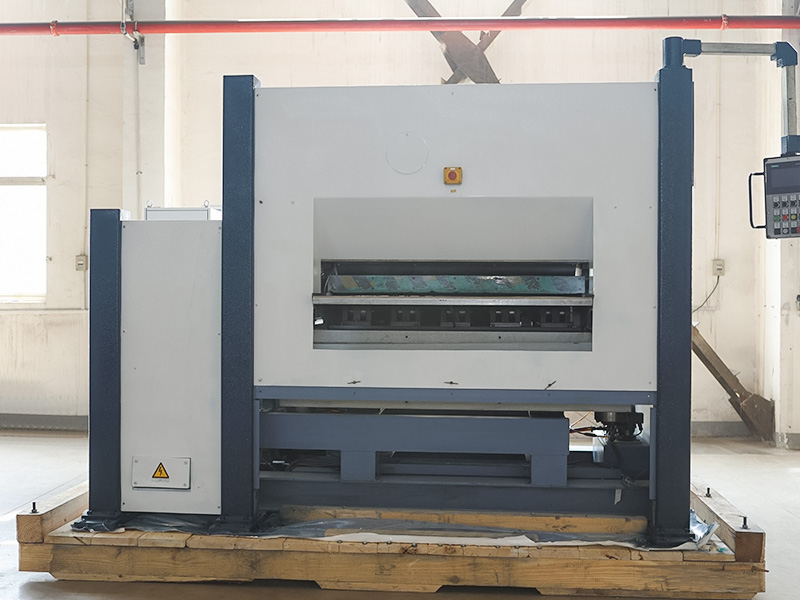
A roller leveler holds the sheet between two rows of rollers, an upper row and a lower row, set in a staggered pattern. As the sheet travels through, it is bent up and down around each roller. The first rollers apply the deepest bend, and the last rollers apply a smaller bend so the sheet exits flat. Repeated bending past the yield point evens out the stress difference between fibers across the thickness, which is what makes the sheet stay flat.
Our leveling equipment uses a roller structure with high-hardness steel rollers that go through dynamic balance testing, so force stays even at running speed. The roller gap and pressure adjust to the material and thickness, and the control system monitors the leveling process in real time. You can see the product details on our leveling machine page.
| Method | How it works | Best for | Limits |
| Roller leveling | Repeated bending between staggered rollers | Sheet, plate and cut parts in steady production | Small parts need carrier plates or special rollers |
| Press straightening | Local pressure applied to high spots | Heavy plate, local distortion, one-off repairs | Slow, depends on operator judgment |
| Stretch leveling | Pulling the sheet past yield along its length | Large, high-quality sheet such as aluminum plate | Large equipment, specialized |
| Manual hammering | Hand work on distorted areas | Occasional small fixes | Inconsistent, leaves surface marks |
For a fabrication shop handling mild steel, stainless steel and aluminum in mixed thicknesses, roller leveling is the practical choice because it handles sheet and cut parts, runs in line with other equipment and stays consistent from batch to batch.
Carbon steel, stainless steel and aluminum respond differently. Stainless work-hardens and springs back more, so it usually needs more roller penetration than mild steel at the same thickness. Aluminum marks easily, so keep rollers clean.
Thicker material needs larger rollers, a wider pitch and more force. Thin gauge needs smaller rollers and backup rollers to avoid oil-canning, where the sheet dimples between rollers.
The entry gap sets the deepest bend and the exit gap sets the final flatness. Entry gap too small marks the surface. Exit gap too large leaves residual curve.
Polished, brushed and coated sheets need clean rollers and sometimes a protective film. Dirt on a roller prints onto every sheet that follows.
Check flatness with a straightedge or a gauge on a reference table after the first pass, and again on the first part after cutting. Record the settings that worked for each material and thickness so the next batch starts from a known point.
Level before cutting when the raw sheet shows coil set, edge wave or center buckle, or when you cut with a laser or punch at tight tolerances. This protects the cutting head, keeps the nest accurate and releases the stress that would otherwise open up as parts separate. It is the standard choice for any shop cutting long runs of sheet from coil-cut stock.
Level after cutting when cutting itself introduces distortion, for example thin parts cut from a dense nest or parts with large cutouts that release stress unevenly. Parts leveling brings the cut pieces back to flat before they reach the bending machine. Add a carrier sheet for small parts so they pass through the rollers without tipping.
Level both times for parts that will be welded into assemblies or coated to a visible finish. The extra step costs minutes and saves rework at fit-up and finishing. For the full process order, see our Custom Sheet Metal Fabrication guide and the notes on tolerance stacking in Precision Sheet Metal Components.
Match the machine to your material range, not to your largest occasional job. Define the thickest and thinnest sheet you run, the widest sheet, the materials, the surface finish requirements and the daily volume. Then ask the supplier to demonstrate on your own sheet. At Shaofang we provide OEM and ODM support, so leveling equipment can be configured for special thicknesses or inline use with cutting and bending. Send your specifications through the contact page.
Yes. The cutting head tracks the sheet height, and large waves cause collision stops, focus shifts and poor edge quality. Flat sheet also improves nesting accuracy and reduces part tip-ups.
It can, with the right roller diameter and support rollers. Thin sheet is prone to oil-canning, so it needs smaller rollers, careful gap setting and slower speed than thick plate.
Clean, polished rollers and a clean sheet surface avoid most marking. For visible surfaces, use a protective film or confirm roller condition before each run.
The terms overlap. Leveling usually means removing waves and flatness errors across a sheet, while straightening often refers to correcting bars, profiles or localized bends. Roller equipment does both within its limits.
Yes, by placing them on a carrier plate or using a leveler designed for parts. Without support, small pieces can tip or jam between rollers.
Flat at delivery does not mean stress-free. Parts can still move after cutting. Test with your own cutting layout, and if parts move or angles drift, add a leveling step.













 +86-13771171111 +86-13338110517


 English
 中文简体
 日本語
 Deutsch
 Español
 Bahasa Melayu