Introduction
Automated spray coating systems have become essential in modern manufacturing, improving efficiency, product quality, and safety. Using robotic mechanisms and intelligent controls, these systems apply coatings uniformly on various surfaces, reducing human error, material waste, and ensuring consistent thickness.
Driven by the need for higher production, better surface quality, and sustainability, industries increasingly adopt robotic, powder, and electrostatic spray coating solutions. These systems handle complex geometries and high volumes while precisely controlling spray parameters. Intelligent algorithms enable process optimization, cost reduction, and superior finishes.
Overview of Automated Spray Coating Systems
-
Definition & Purpose: Automated spray coating systems apply coatings (paint or protective layers) to workpieces with high precision and repeatability, integrating mechanical, electronic, and software components.
-
Advantages over Manual Spraying:
- Precise control of atomization, flow rate, and coverage angle.
- Ensures uniformity and high-quality finish.
-
Types of Spray Coating Technologies:
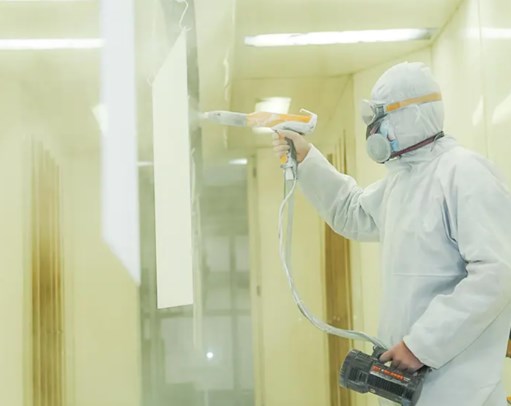
- Powder Coating Automation: Uses electrostatically charged powder; cured under heat; reduces waste; durable; widely used in automotive, metal fabrication, appliances.
- Electrostatic Spray Coating: Uses electrically charged paint particles for uniform coverage and adhesion, especially on complex shapes.
- Liquid Spray Coating / Robotic Systems: Handles complex 3D surfaces; adjusts spray paths, angles, and flow rates in real time; ensures even coating and reduced overspray.
-
Operational Benefits:
- Consistent coating quality across large production volumes.
- High throughput with minimal human intervention.
- Can integrate with production lines for automated spraying, curing, and quality inspection.
-
Safety & Environmental Benefits:
- Reduces worker exposure to VOCs and repetitive motion injuries.
- Intelligent controls monitor temperature, humidity, and adjust parameters for optimal coating.
- Supports environmental compliance.
- Minimizes material waste, overspray, and energy consumption.
-
Industrial Adaptability:
- Handles metals, plastics, composites.
- Applicable to automotive parts, industrial machinery, consumer electronics, appliances.
- Enhances efficiency, product quality, and aesthetic precision.
-
Key Advantages: Versatile, reliable, scalable, and essential for modern manufacturing.
Core Technologies and Equipment Components
Core Functions of Automated Spray Coating Systems
| Function |
Description |
Benefits |
| Spray Technology |
Precisely controls atomization and flow of paint |
Ensures uniform coating and consistent thickness |
| Intelligent Control System |
Automatically adjusts spray speed, distance, and angle |
Optimizes coating quality for various materials and shapes |
| Surface Adaptation |
Adjusts parameters based on material type |
Enhances adhesion and protective properties |
| Production Line Integration |
Coordinates with spray booths and conveyors |
Improves efficiency and reduces labor costs |
- Versatility in Coating Methods: Automated spray systems support powder, electrostatic, and liquid coatings, offering durability, efficiency, and precise coverage.
- Efficiency and Precision: Robotic systems reduce paint waste, ensure uniform application, and handle complex surfaces with high repeatability.
- Safety and Ergonomics: Automation minimizes operator exposure to fumes and repetitive strain, with intelligent systems detecting abnormalities and adjusting processes automatically.
- Material and Application Flexibility: Systems adapt to various materials and coating types, from protective metal coatings to decorative or specialized industrial finishes.
- Technological Integration: Integration with IoT, machine learning, and data analytics enables predictive maintenance, process optimization, and adaptive control.
Applications and Case Studies
-
Automotive Industry:
- Robotic spray systems provide precise, consistent paint application on car bodies, panels, and parts.
- Intelligent controls adjust spray parameters for different materials and complex shapes.
- Results: high-quality, protective, and aesthetic finishes.
-
Metal Fabrication & Industrial Manufacturing:
- High-efficiency robotic spray coating ensures uniform coverage and optimal thickness.
- Automated powder coating reduces material waste and enhances productivity.
- Integration with handling equipment allows continuous operation and minimal downtime.
-
Consumer Electronics & Appliances:
- Electrostatic spray coating ensures consistent coating on small, intricate components.
- Automatic control of speed, distance, and angle improves appearance and protection.
-
Large-Scale Manufacturing:
- Automated spray booths provide controlled environments for consistent quality.
- Integration with production lines reduces manual handling and increases throughput.
- Industries: aerospace, heavy machinery, industrial equipment.
-
Case Studies:
- Automotive: reduced paint consumption, better uniformity, faster cycles.
- Metal fabrication: improved corrosion resistance and product longevity.
- Emerging sectors: EVs, medical devices, renewable energy equipment adopt automated coatings.
Industry Trends and Market Outlook
-
Automation & Intelligent Control:
- Integration of sensors, data analytics, and adaptive algorithms optimizes spraying in real time.
-
Sustainability:
- Powder and electrostatic coating reduce overspray and VOC emissions.
- Precise application saves energy and materials.
-
Industry 4.0 & Smart Manufacturing:
- Networked systems enable real-time monitoring, predictive maintenance, and process optimization.
-
Market Demand:
- Adoption growing in automotive, aerospace, electronics, appliances, and renewable energy sectors.
- Small and medium-sized manufacturers expected to adopt as technology costs decrease.
-
Technological Innovations:
- Advanced sensors, machine learning, and robotic systems handle complex workpieces efficiently.
User Guide and Technical Recommendations
-
Key Considerations for System Selection:
- Spray technology type, automation level, material adaptability, and production line integration.
-
Coating Methods:
- Powder coating: durable, corrosion-resistant finishes.
- Electrostatic spray: high coverage for complex surfaces.
- Liquid coatings: precision for decorative and functional applications.
-
Intelligent Control Systems:
- Automatically adjust speed, distance, and angle based on workpiece.
- Predefined parameters allow quick changeovers and reduce setup time.
- Real-time monitoring and adaptive adjustments improve quality and reduce waste.
-
Integration with Production Lines:
- Automated spray booths maintain controlled environment.
- Synchronization with conveyors and handling systems improves efficiency and throughput.
-
Maintenance & Safety:
- Reduces operator exposure to fumes and injuries.
- Regular maintenance of spray guns, controllers, and air supply is necessary.
- Intelligent systems provide diagnostic alerts for proactive troubleshooting.
Conclusion
Automated spray coating systems have revolutionized modern manufacturing by combining precision, automation, and intelligent control. These systems provide consistent, uniform coatings while reducing material waste, labor costs, and environmental impact. From automotive parts to industrial machinery and consumer electronics, automated spray coating systems enhance both aesthetic and protective properties of surfaces across a wide range of applications.
The integration of robotic spray coating systems, powder coating automation solutions, and automated spray booth systems demonstrates the versatility and efficiency of this technology. Intelligent control systems further enhance performance by adjusting spray parameters in real time, accommodating different materials and complex geometries. High-efficiency robotic spray coating for metal surfaces exemplifies how automation improves both productivity and coating quality.
FAQ
Q1: What types of surfaces can automated spray coating systems handle?
A1: Automated spray coating systems can accommodate metals, plastics, wood, and composites, automatically adjusting spray parameters to ensure uniform coating and optimal adhesion.
Q2: How does the intelligent control system improve spray quality?
A2: The intelligent control system automatically adjusts spray speed, distance, and angle according to workpiece shape, material, and coating requirements, ensuring precise and consistent finishes.
Q3: What are the main advantages over manual spray painting?
A3: Automated systems provide higher efficiency, consistent coating thickness, reduced material waste, and improved worker safety, while minimizing human error and rework.
Q4: How are automated spray coating systems integrated into production lines?
A4: These systems can synchronize with conveyors, robotic handling equipment, and spray booths to enable continuous operation, reduce manual handling, and optimize production efficiency.
Q5: What maintenance is required for these systems?
A5: Regular checks of spray guns, control systems, and air supply lines are recommended. Intelligent systems often provide diagnostics and alerts to simplify maintenance and prevent downtime.






 +86-13771171111 +86-13338110517

 English
 中文简体
中文简体 日本語
日本語 Deutsch
 Español
 Bahasa Melayu