Content
Automatic welding machines, as important equipment in modern industrial production, have gradually replaced traditional manual welding methods. They not only improve production efficiency but also demonstrate significant advantages in welding precision and quality control. With continuous technological advancements, automatic welding machines have been widely applied in various industries.
An automatic welding machine is an automated welding device that integrates robotic technology, sensor technology, and computer control technology. Compared to traditional manual welding, automatic welding machines can complete welding processes efficiently and with high precision. Through program control, the automatic welding machine can automatically adjust welding parameters, ensuring the quality and consistency of each weld. Its working principle is usually based on a numerical control system, which can precisely control key parameters such as welding speed, temperature, and pressure, thus achieving an efficient and stable welding process.
The core technology of an automatic welding machine is the computer control system, which sets key parameters such as welding path, welding speed, and current through programming. Sensors and feedback systems inside the machine monitor every aspect of the welding process in real time to ensure welding quality. The welding head (or welding electrode) of the automatic welding machine can move automatically according to the preset path, performing high-precision welding tasks. At the same time, various welding methods such as arc welding, laser welding, and spot welding can be flexibly switched according to different materials and process requirements to achieve the best welding results.
Compared with traditional welding processes, automatic welding machines have higher stability and consistency. During long-term production, automatic welding machines can work continuously with almost no errors caused by human operation. Therefore, automatic welding machines are widely used in industrial production scenarios that require high quality and high stability.
One of the most significant advantages of automatic welding machines is their ability to greatly improve production efficiency. Because the welding process is completely controlled by the machine, the production line can carry out welding operations continuously, greatly reducing downtime caused by manual welding. Automatic welding machines can complete welding tasks in a shorter time, significantly shortening the production cycle.
Another significant advantage of automatic welding machines is their excellent welding quality. The automated control system can precisely adjust key parameters such as current, voltage, and speed, ensuring the consistent quality of every weld. Factors such as temperature and pressure during the welding process can be precisely controlled, avoiding welding defects caused by improper manual operation. More importantly, automatic welding machines can perform repetitive tasks multiple times, ensuring a high degree of consistency in welding quality.
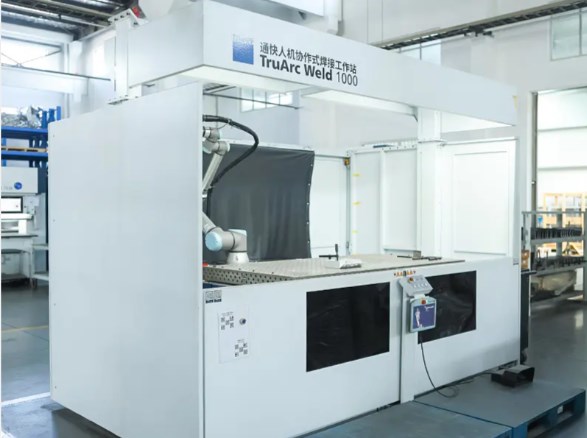
Due to the automated control of the welding process, errors and inconsistencies in manual operation are reduced. Automatic welding machines ensure the consistency and stability of the welding process, thus reducing potential quality fluctuations during production. This not only improves the product pass rate but also reduces rework and scrap, lowering production costs.
In modern industrial production, manual welding usually requires highly skilled workers, and the operation process is cumbersome and dangerous. The use of automatic welding machines eliminates the need for a large number of manual workers in the welding process, thus significantly saving labor costs. Through automated management, companies can better allocate human resources to other positions, improving overall production efficiency.
Due to their high efficiency and high precision, automatic welding machines have been widely used in various industries. They play an important role in automotive manufacturing, electronic equipment, aerospace, construction, and petrochemical industries.
The automotive manufacturing industry is one of the most widely used fields for automatic welding machines. On modern automotive production lines, a large amount of welding work is completed by automated equipment. Automatic welding machines can complete the welding of key components such as car bodies and chassis on high-speed production lines. Compared with manual welding, automatic welding machines can improve production efficiency, ensure welding quality and strength, and enhance the safety and reliability of automotive products.
In the aerospace field, automatic welding machines are mainly used for welding important components of aircraft and spacecraft. Because the components of spacecraft need to withstand extremely high pressure and temperature, the welding process requires extremely strict standards. Automatic welding machines can provide high-precision welding, ensuring that every component meets strict quality standards.
In the construction and petrochemical industries, there is a huge demand for welding of pipelines and steel structures. Automatic welding machines are widely used in these industries, especially in long-distance pipeline welding and high-strength steel structure welding, where automatic welding machines can provide more efficient and safer solutions.
Automatic welding machines can be used for welding a variety of materials, including common metal materials such as steel, stainless steel, aluminum alloys, and copper alloys. For different materials, automatic welding machines can adjust welding parameters according to the requirements of the welding process to ensure optimal welding results.
The maintenance of automatic welding machines is relatively simple. Regular inspection of key components such as the welding head, sensors, and power system, and timely replacement of worn or damaged parts, can ensure the normal operation of the equipment. At the same time, the control system of the automatic welding machine also has a self-diagnostic function, which can promptly detect and report fault problems.
Although automatic welding machines are typically used in large-scale production, with technological advancements, modern automatic welding machines can now achieve flexible production, adapting to the needs of small-batch, multi-variety production. By adjusting programs and welding parameters, automatic welding machines can also play an important role in small-batch production.
As an important technology in modern manufacturing, automatic welding machines are gradually changing traditional production models. By improving welding quality, increasing production efficiency, and reducing production costs, automatic welding machines have brought tremendous changes to industrial manufacturing. With continuous technological advancements, future automatic welding machines will become more intelligent and precise, providing more efficient and reliable solutions for production in various industries.













 +86-13771171111 +86-13338110517

 English
 中文简体
中文简体 日本語
日本語 Deutsch
 Español
 Bahasa Melayu