Content
A press brake bends sheet metal by pressing it between an upper tool, the punch, and a lower tool, the die. The sheet sits on the die, a back gauge sets how far the edge reaches in, and the ram drives the punch down to force the metal into the die opening, creating a bend. The angle comes from how deep the punch travels, and the force needed, the tonnage, depends on the material, its thickness, the die opening and the length of the bend.
The moving upper beam that carries the punch down and back up. It is driven hydraulically or electrically on modern machines.
The tooling pair that shapes the bend. Punch geometry and die opening decide the radius, the angle and the force.
The rigid lower beam that holds the die. Its stiffness keeps the bend angle even along the length.
Fingers that locate the sheet so each bend lands in the right place, part after part.
Sets and controls bending angle, length and other parameters. Shaofang describes its bending machines as using a high-precision CNC system.
The structure that resists deflection. Good rigidity and stability reduce processing errors.
The operator selects the part program with material, thickness, bend angle and bend length.
The punch and die are installed and aligned to suit the thickness and the shape of the part.
The back gauge positions the sheet so the bend line falls over the die opening.
The ram moves down and the punch forces the sheet into the die. Travel depth sets the angle.
The ram returns, the part is checked, and the control corrects the angle if it needs adjusting.
The part is turned or flipped and the cycle repeats until all bends are formed.
The same press brake can form a bend in three ways. The method changes the force you need and how accurate the angle is.
| Method | How It Works | Force Needed | Typical Use |
| Air bending | The punch pushes the sheet into the die without touching the bottom | Lowest | General fabrication, flexible tooling |
| Bottoming | The sheet is pressed against the die walls for a defined angle | Higher | Parts needing tighter angle repeatability |
| Coining | The punch presses hard enough to set the metal into the die shape | Highest | Precision work with minimal springback |
Springback is the reason methods differ. Metal tries to return slightly toward flat after the punch lifts, and the control compensates for it by bending a little past the target angle.
Treat this as a first estimate. Always check the tonnage chart for your machine and tooling, because actual force varies with the material grade, the tool and the method.
The tooling decides what you can form. The Shaofang bending page lists four blade types in its knowledge section, and the machines are described as adaptable to molds of different specifications.
| Tool Type | Best For |
| V-shaped blade | Thin sheets and precise angular bends |
| U-shaped blade | Medium thickness sheets, reducing springback |
| Box blade | Heavy sheets and wide bend areas |
| Custom-profile blade | Complex parts needing high accuracy |
For a custom bracket or a formed enclosure, the cheapest route is often a standard V die with a custom hold-down or relief, rather than a one-off tool.
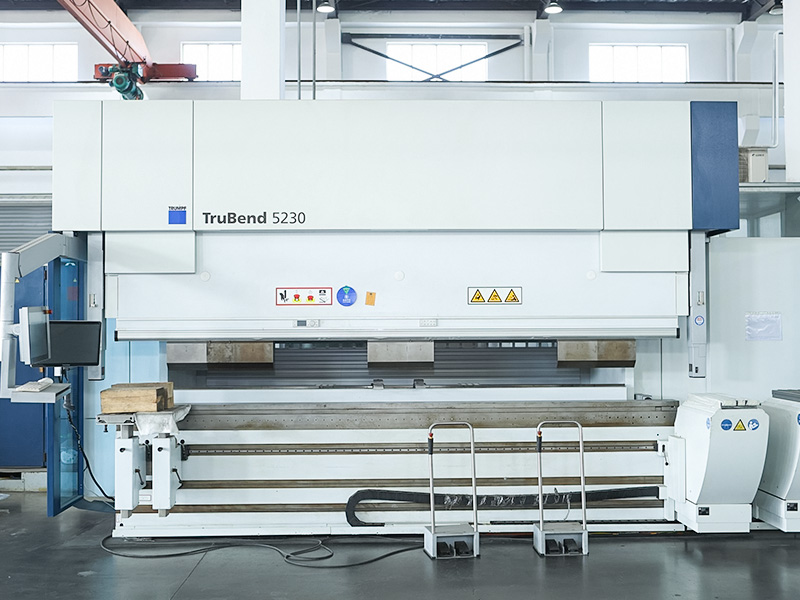
Tonnage and bed length together set the part sizes a shop can bend. The Shaofang bending page lists CNC press brakes and bending centers with capacities from small to heavy.
| Machine Listed | Capacity | Typical Class |
| Bystronic Xpert40 | 40 tons, 1 meter | Small precision parts |
| TRUMPF TruBend7036 | 36 tons, 1 meter | Small precision parts |
| TRUMPF TruBend5130 | 130 tons, 3 meters | Medium length parts |
| TRUMPF TruBend5170 | 170 tons, 3 meters | Heavier, longer parts |
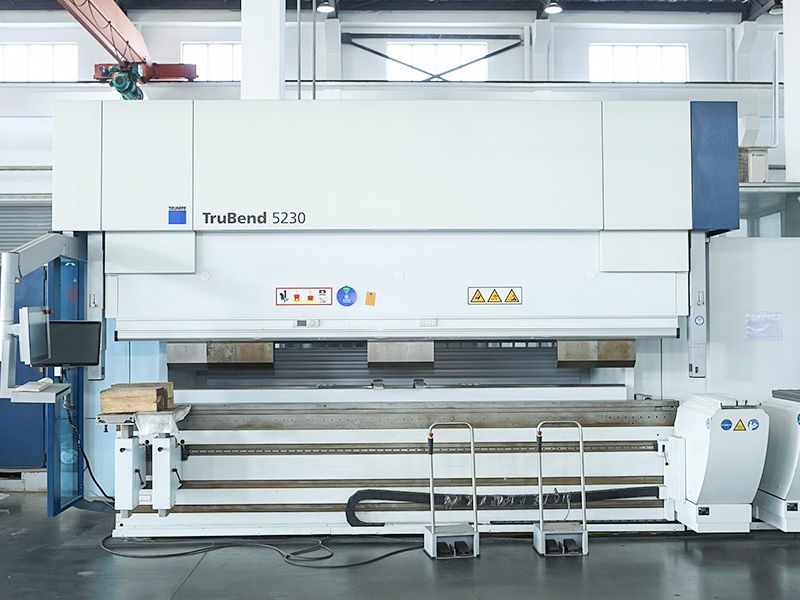
| TRUMPF TruBend5230 | 230 tons, 4 meters | Large and thick parts |
| TRUMPF TruBend5320 | 320 tons, 4 meters | Heavy plate and long bends |
Full details are on the bending machine page. Bending is one step in the wider sheet metal fabrication workflow, and flat blanks usually come from the laser cutting or punch press stage first.
| Problem | Likely Cause | Fix |
| Angle varies along the bend | Tool wear, uneven bed deflection or misalignment | Check tool condition and alignment, and use crowning if the machine has it |
| Angle too open after bending | Springback not compensated | Bend slightly past target or use a narrower V die |
| Cracking on the outside of the bend | Radius too tight for the material | Increase the bend radius or bend across the grain |
| Part dimensions off after bending | Back gauge or bend allowance error | Recheck the flat pattern and gauge reference |
| Marks on the surface | Dirty tools or hard die edges | Clean tooling and use protective film or soft inserts |
Most defects trace back to tooling, setup or the flat pattern, not to the machine itself. Confirming the first part before a full batch catches the majority of them.
When sheet is bent, the outside stretches and the inside compresses, so the flat length you cut is not the sum of the finished flange lengths. The flat pattern has to account for this, using a bend allowance or deduction that depends on the material, the thickness, the bend radius and the angle.
Programming software normally calculates it, but the numbers only work when the tooling and the material match what the program assumes. If you supply drawings for custom parts, state the material, the thickness and the inside bend radius so the flat pattern is right the first time.
Press brakes are grouped by how the ram is driven. The Shaofang page does not describe the drive type of each listed machine, so treat this as general background.
It presses sheet metal between a punch and a die. The back gauge positions the sheet, and the ram drives the punch down to form the bend at the set angle.
A common first estimate for mild steel air bending is tons per foot = 575 x t x t / V, with thickness and die opening in inches. Check the machine tonnage chart for the actual figure.
Air bending is the lowest force and most flexible, bottoming presses the sheet against the die for a more repeatable angle, and coining uses the highest force to set the shape.
Carbon steel, stainless steel and aluminum alloys are listed on the Shaofang bending machine page.
It is the small return toward flat after the punch lifts. Operators and the CNC control compensate by bending slightly past the target angle.













 +86-13771171111 +86-13338110517


 English
 中文简体
 日本語
 Deutsch
 Español
 Bahasa Melayu