Content
Walk into any finishing shop that still coats parts by hand, and you will see the same pattern. The operator sets gun distance by feel, adjusts atomization pressure by ear, and judges the coat by the gloss of the wet paint. By the fiftieth part, the dry film thickness has drifted; edges show runs, flat areas show thin patches, and a share of the batch comes back from inspection as rework. An automated spray coating system removes that variability by placing every coating parameter under machine control: the same gun path, the same fluid delivery, and the same atomization condition on part one and part one thousand.
This guide covers what automated spray coating systems are, the main machine types, the benefits that justify the investment, and the factors to settle before you place an order.
An automated spray coating system is a production machine that applies a liquid or powder coating to workpieces without an operator guiding the gun. The workpiece travels on a conveyor or sits on a rotating fixture, while one or more fixed, reciprocating, or rotary-mounted guns apply the coating in a controlled mist.
Automation matters because coating quality depends on parameters that are difficult to keep stable by hand. A modern system regulates:
Once these values are set in the control system, they do not change during a shift. That repeatability is the foundation of every other benefit this equipment offers.
Automated systems are usually classified by the way the gun moves across the workpiece. Four layouts cover most industrial applications: fan coaters, reciprocating spray machines, rotary spray machines, and linear spray machines.
| System type | How it applies the coating | Best fit |
|---|---|---|
| Fan coater | Fixed or slowly oscillating guns produce a wide, flat fan pattern over a moving surface | Flat sheets, panels, and board materials in continuous production |
| Reciprocating spray machine | A gun carriage moves up and down while the part passes horizontally on a conveyor | Medium- to high-volume parts with one dominant flat or gently curved face |
| Rotary spray machine | Guns sweep in a circle around the part, or the part rotates on a spindle inside the booth | Three-dimensional parts that need coverage on several sides |
| Linear spray machine | Guns travel in a straight line along the length of the workpiece | Long profiles, extrusions, and structural components |
Select the layout by geometry first and by speed second. A flat panel is wasted on a rotary machine, while a complex part will defeat a fan coater. If your product range changes seasonally, choose a booth and conveyor arrangement that accepts several part sizes rather than one optimized setup. Our automated spray coating equipment covers both individual stations and complete conveyorized lines, so the right answer is usually a configuration adapted to your part envelope and cycle time rather than a standard catalog model.
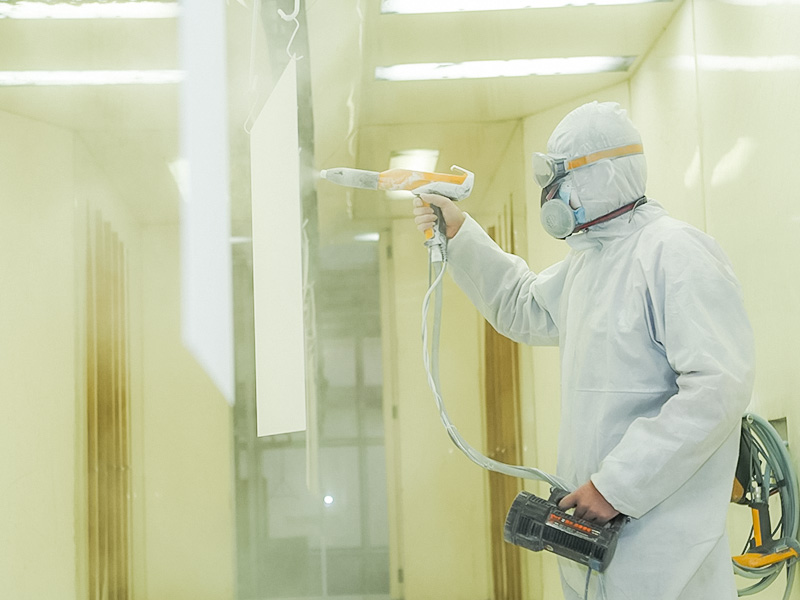 Custom Automated Spray Coating Systems Manufacturers, FactoryWuxi Shaofang Machinery Co., Ltd. is China Custom OEM/ODM Automated Spray Coating Systems Manufacturers, Factory, We Possess Advanced And...View Product →
Modern systems store a recipe for each part number. When the part changes, the conveyor speed, gun stroke, atomization settings, and coating flow switch together, which matters when the same line processes a variety of products across one shift.
The business case for an automated spray coating system rests on three measurable improvements: finish consistency, material efficiency, and throughput.
Coating standards judge a finish by dry film thickness and appearance across the entire part. Manual spraying naturally produces variation, and variation shows up as rejects. An automated gun holds its distance, its speed, and its spray angle, so film thickness stays within a narrow band from part to part. For suppliers who certify surface quality against a customer specification, this repeatability alone can justify the investment.
Overspray is wasted coating and wasted money. A controlled spray pattern, consistent atomization, and consistent gun travel reduce overspray well below what a hand operator produces over a full shift. In most finishing shops, coating material is the single largest consumable cost, so the savings compound as soon as the line runs continuously.
An automated system does not slow down during the last hour of a shift, and one operator can supervise a booth that would otherwise require two or three painters. The same change removes operators from direct exposure to solvent mist and overspray, which improves working conditions and simplifies compliance with ventilation and exposure limits.
The gains depend on the parts entering the booth as much as on the booth itself. Consistent results start with a consistent substrate, and process inspections at each stage are far easier to maintain when the application step is automated. Our quality control procedures follow that logic, with checks at every process step and a final inspection against the customer specification.
Most coating lines underdeliver because the machine was chosen before the parts were defined. A short scoping process prevents the classic mistakes: a booth too small for next year's parts, a conveyor that cannot reach the required line speed, or guns that cannot access deep recesses.
Collect the representative parts you will run: envelope size, weight, geometry, and target quantity per shift. These values determine conveyor width, booth length, and the number of guns.
Define the dry film thickness, appearance, and the test standard the parts must meet. The finish target determines the spray technology and the level of process control required.
Air spray reaches complex shapes, airless systems are efficient on large flat surfaces, and electrostatic charging improves coverage uniformity on conductive parts. The geometry from step one decides which method fits.
Test the line with your own parts and coating material. Adjust gun distance, atomization pressure, and conveyor speed, then measure film thickness across the part and lock the parameters into the recipe.
This is where a custom configuration earns its keep. Standard machines suit standard parts; a line built around your actual mix avoids the compromises that cause rejects later. We see this daily in our custom services work, where a customer's drawings and process targets drive the mechanical design instead of the other way around.
Surface condition before coating matters as much as the spray itself. Parts coming out of forming and welding stations often carry burrs, scale, or roughness that becomes visible under a glossy finish. Many finishing lines therefore start only after parts pass through industrial polishing equipment, so the substrate is uniform before the first coat is applied.
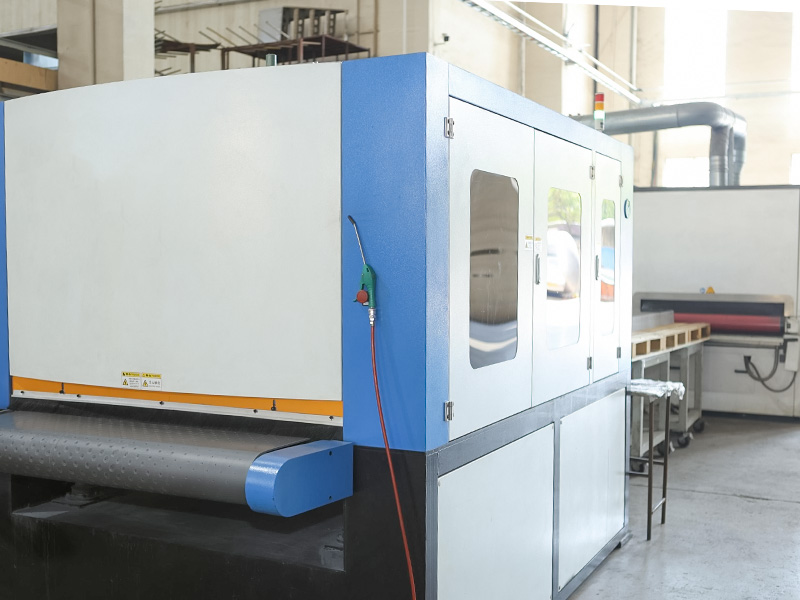 Custom Industrial Polishing Equipment Manufacturers, FactoryWuxi Shaofang Machinery Co., Ltd. is China Custom OEM/ODM Industrial Polishing Equipment Manufacturers, Factory, Our Machines Ensure Unif...View Product →
How do I know whether my volume justifies an automated spray coating system?
If the coating station runs more than one shift, if finish consistency is generating rework, or if a single skilled operator limits throughput, automation is worth evaluating. Count current rejects and coating material consumption before the purchase; both trend downward after automation.
What coating materials can an automated system handle?
Solvent-based paints, waterborne coatings, primers, clear coats, and powder coatings can all be applied automatically. The system must be specified for the material: fluid lines and atomizers differ for high-solids paints, and powder requires a different booth and recovery arrangement.
Can an automated system be integrated into an existing line?
Yes. Most installations are retrofits, with the conveyor, booth, and curing section matched to the available floor space and the existing part flow. Feasibility depends on the space, not on the age of the surrounding equipment.
How much floor space does a typical system require?
A single spray booth with one reciprocating machine needs roughly the same footprint as a large manual booth; the conveyor and curing sections are what extend the line. A complete floor layout is normally produced during the quotation stage, before any commitment is made.
An automated spray coating system restores certainty to the finishing stage: predictable film thickness, repeatable color and texture, lower material consumption, and a line that does not degrade between shifts. Start with your part drawings and a target output, choose the machine layout around the geometry, and validate with trials before you commit to full production. If you are evaluating a new line, contact our engineering team with your part specifications and cycle time target; we respond within one working day with a configuration and a realistic commissioning plan.





 +86-13771171111 +86-13338110517

 English
 中文简体
中文简体 日本語
日本語 Deutsch
 Español
 Bahasa Melayu